Wired vs Wireless Security Cameras for East Texas Homes

A camera that watches the driveway only helps if it keeps recording when you need it. In East Texas, that means thinking about pine-covered lots, long rural driveways, detached shops, summer lightning and winter ice storms before you pick a system. The big decision is wired or wireless, and the labels are less clear than they sound. Here is how the options compare for homes around Tyler and Longview, and where our security camera system installation fits.
What “wired” and “wireless” really mean
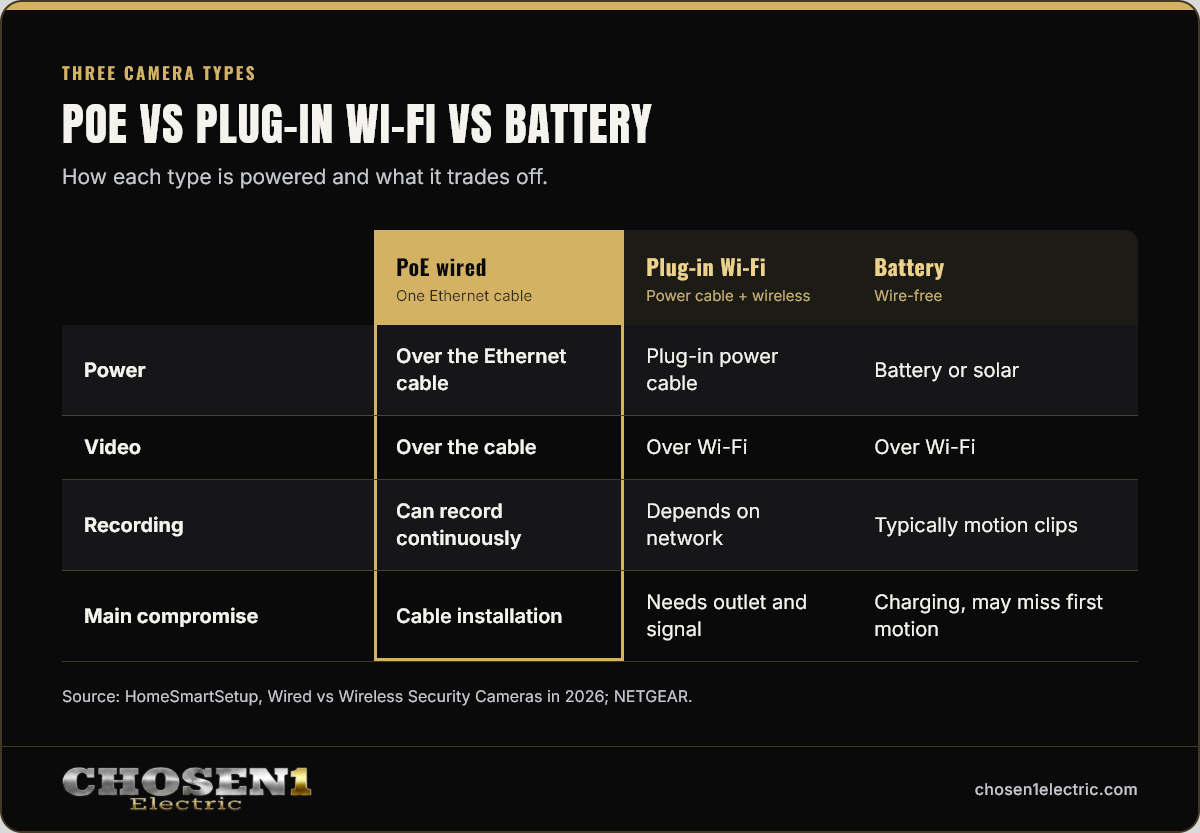
There are three common types, not two. A PoE (Power over Ethernet) camera uses a single Ethernet cable for both power and data. A plug-in Wi-Fi camera sends video over wireless but still needs a power cable. A battery camera is truly wire-free, but it sleeps between events. In other words, “wireless” often just means the video travels over Wi-Fi, and the camera may still need an outlet.
Where wired PoE cameras win
PoE cameras get stable power and bandwidth without competing for Wi-Fi airtime. Paired with a network video recorder (NVR) kept inside the house, they can record continuously, and a properly set up local system keeps recording during an internet outage, though remote alerts may stop. NETGEAR notes that the IEEE PoE standards (802.3af, 802.3at and 802.3bt) all support runs up to 100 meters, about 328 feet, including patch cables. That covers most front-yard and driveway positions. A far-off barn or gate may need a switch partway or a different approach.
The tradeoff is installation. Cable has to be routed through attics, walls and exterior penetrations and sealed against weather, which is why a PoE system is usually best done by a pro.
Where wireless cameras win
Battery cameras are quick to mount and work well at a detached shed, a gate or a rental where drilling is not an option. The compromise is that they typically wake on motion, so they can miss the first moment someone enters the frame, record event clips instead of continuous video, and need periodic charging. A busy road can drain a battery quickly, while a quiet side gate may last far longer. Plug-in Wi-Fi cameras are a good middle ground for a garage or porch near an outlet, but they depend on your router and signal strength.
East Texas factors that change the answer
Ice storms and outages
Winter outages knock out the router and modem along with everything else. A PoE system, its switch, the router and the NVR can all run from one appropriately sized UPS (battery backup), so recording can continue through a short outage. Battery cameras keep their own power, but without a working router they may not be able to send alerts or clips. Our ice storm electrical safety guide covers what else to plan for.
Lightning
Long outdoor cable runs and exterior-mounted gear are exposed to storms. Use surge protection suitable for outdoor runs, and see why East Texas homes may need a whole-home surge protector or ask about grounding and surge protection.
Rural lots and outbuildings
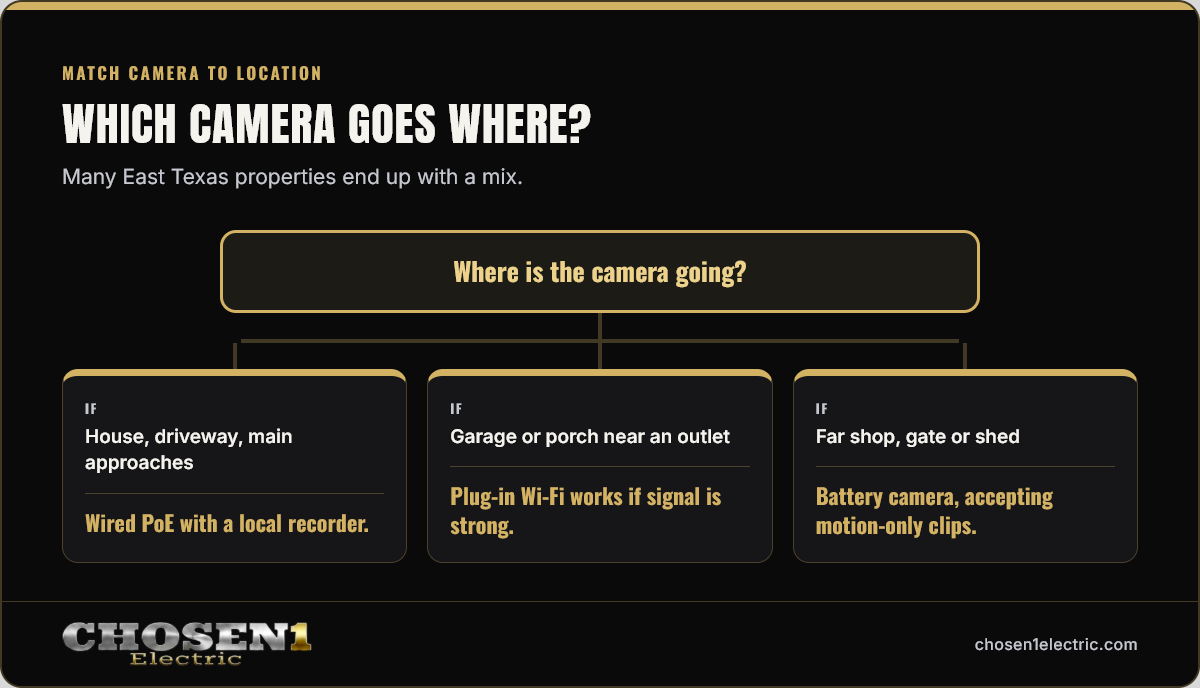
Detached shops and long driveways often sit beyond comfortable cable range or Wi-Fi coverage. Many homes end up with a hybrid: PoE on the main approaches, and a battery or plug-in camera at the far building.
Cybersecurity and who should install it
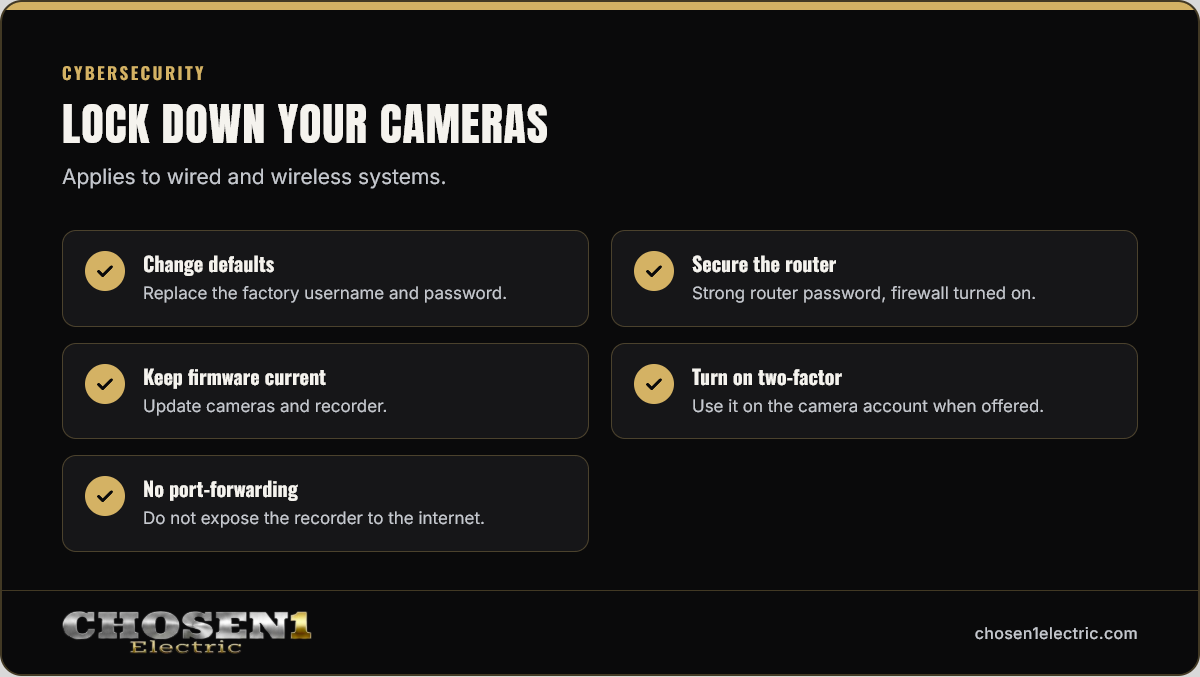
Either type can be hacked if it is set up carelessly. The FTC advises securing the home router with a strong password and turning on its firewall, and consumer security guidance consistently recommends changing default usernames and passwords, keeping firmware updated, and turning on two-factor authentication when it is offered. Do not port-forward a recorder to the internet.
On licensing, the Texas Department of Public Safety has said that selling and installing a camera system that records images falls within the Private Security Act’s definition of an alarm system, so a license is required to sell or install one. Separately, Texas requires non-exempt electrical work to be done by a licensed electrician working through a licensed electrical contractor, according to the Texas Department of Licensing and Regulation (TDLR). When you hire anyone, ask about both.
Wired vs wireless security camera FAQ
Do wired cameras work without internet?
A local PoE system with an NVR can keep recording without internet. Remote viewing and notifications usually stop until the connection returns.
Can battery cameras record 24/7?
Typically no. Continuous recording would drain the battery quickly, so most record motion events only unless connected to permanent power.
Is PoE hard to install?
The concept is simple, but routing cable through attics, masonry and exterior walls, plus weather sealing, often justifies a professional.
Which is better for a rural East Texas property?
Often a mix. Wired PoE covers the house and main approaches, and a wireless camera covers a far shop or gate.

We serve homes in Tyler and Longview and across East Texas. To plan a camera system for your property, call Chosen 1 Electric at (903) 225-8558 or schedule a visit.