How Much Does It Cost to Rewire a House in East Texas?

It’s a Saturday in Longview, and you’re standing in a 1960s ranch house you just bought. The paint is fresh and the kitchen looks great, but every time the toaster and the microwave run together, a breaker trips. The inspector mentioned the wiring is “original.” Now you’re wondering what a rewire would actually cost, and whether you can put it off.
The honest answer is that it depends on your house, and published estimates vary a lot. Below, we break down the price ranges homeowners see, what pushes a rewire toward the low or high end, and how to tell a real rewire from a smaller fix. If you want someone to look at your wiring in person, our rewires and new construction service starts with a visit to your home.
The short answer: what a rewire costs
We won’t hand you one “East Texas price,” because no honest contractor can without seeing the house. What we can do is show you what national cost guides report, and be clear that they don’t agree with each other.
- Small home (about 1,000 square feet): Bob Vila’s cost guide puts a whole-house rewire at roughly $3,000 to $5,000.
- Larger home (about 3,000 square feet): the same guide cites roughly $9,000 to $15,000.
- Typical whole-house project: Inch Calculator says most homeowners spend $10,000 to $15,000 to rewire an entire home.
- Worst case: both guides say the total can climb as high as $30,000 or more in a large, older home where wiring is hard to reach or walls and ceilings need repair afterward.
Notice that these ranges overlap but don’t match. Some online estimates are far lower because they price a partial job, like a few circuits or a handful of outlets, not a full rewire. Treat any single number you see online as a starting point for the conversation, not a quote.

How a rewire is priced
Rewiring cost is driven largely by labor and by how hard the wiring is to reach. Here is how the math tends to work.
Home size and the number of circuits
Bigger homes need more wire, more boxes, and more hours. Cost guides often express this per square foot, but a 1,500-square-foot house with a workshop, a hot tub and three window units can need more circuits than a 2,200-square-foot house with simple needs. Square footage is a rough guide. The circuit count is what an electrician really prices.
How easy the wiring is to reach
This is the biggest swing factor. A house with an open attic, a crawlspace and accessible walls is far easier than a two-story brick home with finished plaster and no attic path. Where cable can’t be fished, walls or ceilings may need to be opened, and someone has to patch and paint them. Bob Vila notes that costs run toward the top of the range for large older homes with minimal access.
The panel
Many rewires happen alongside a panel upgrade, because old wiring is often paired with an old, crowded panel. Published figures for a service upgrade vary widely by source and by whether the power company has to replace the incoming line. We cover that decision in our guide to 200-amp panel upgrades in East Texas, and our electrical panel services page explains what is involved.
Permits and inspection
Cost guides list electrical permits anywhere from about $50 to $500 or more, depending on the scope and the jurisdiction. We couldn’t find a published permit schedule for a whole-house rewire from either Tyler or Longview, so call your city’s building or permit office before work begins and ask what applies to your address. Generally, a permit and inspection are part of doing the job correctly, and a licensed contractor handles them for you.
Labor rates
Both guides cite electrician labor in the range of roughly $40 to $100 per hour, and rates vary from place to place. That is a national range, not an East Texas rate sheet, so use it only to sanity-check a quote.
Full rewire, partial rewire, or targeted repair
Not every old house needs every wire pulled out. Part of a fair estimate is figuring out which of these three you actually need.
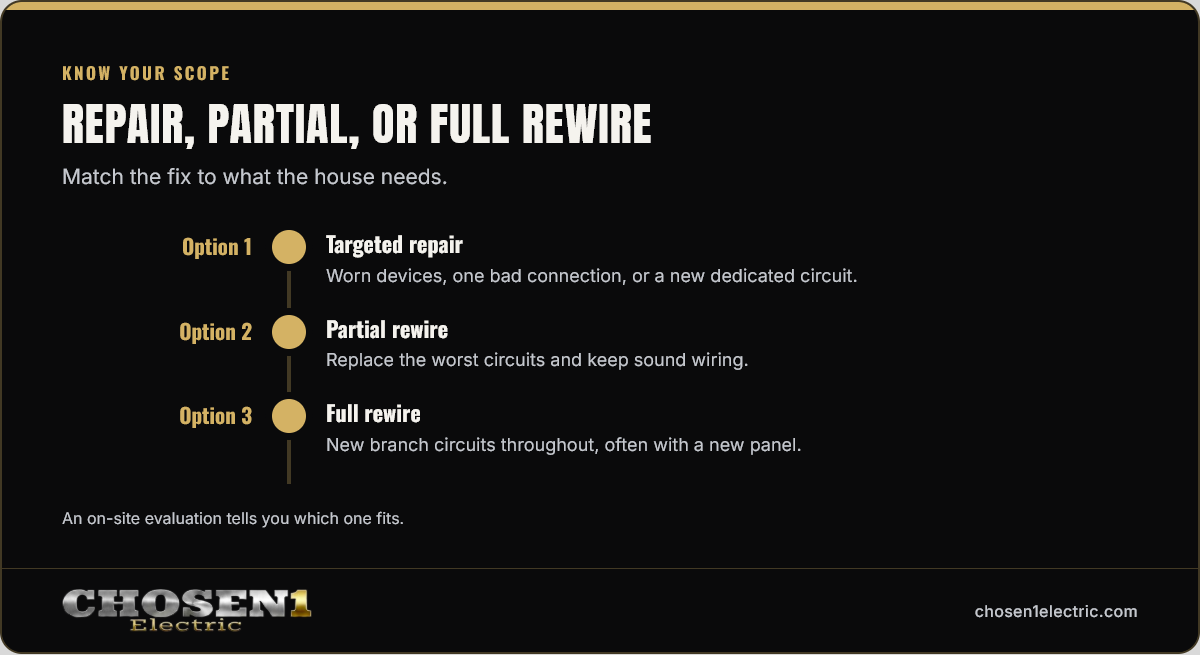
- Full rewire. New branch circuits throughout the house, usually with a new or upgraded panel. This makes sense when the wiring is a type that is being phased out, when insulation is brittle or damaged, or when the house simply can’t carry modern loads safely.
- Partial rewire. Replacing the worst circuits, such as the kitchen, bathrooms, or one wing of the house, and leaving sound wiring alone. This is often the right fit for a house that was added onto over decades.
- Targeted repair or replacement. Swapping worn receptacles and switches, adding a dedicated circuit for an appliance, or fixing a failing connection. Some problems that feel like “the whole house is bad” are one loose connection. Our guide to breakers that keep tripping in Longview homes walks through the common causes.
A good electrician will tell you which of the three fits, and will explain why. If you only hear “you need everything redone” with no look at the panel, the attic, and a sample of outlets, get a second opinion.
East Texas factors that change the number
A few things about homes in Tyler, Longview, and the surrounding towns affect the scope of a rewire.
- Home age. Neighborhoods built in the 1950s through 1970s often have original wiring that was sized for far fewer appliances than a modern family runs.
- Additions and shops. Many East Texas properties have been extended, with a converted garage or a detached shop wired by a previous owner. These add-ons can be the weak link, and they are often worth inspecting first. See our shop and shed wiring service for that side of the property.
- Storm exposure. Heavy storms and power surges stress older wiring and equipment. A whole-home surge protector is worth discussing during a rewire, since the panel is already open.
- Heat and humidity. Hot attics are hard on wire insulation and on anyone working in them, which is one reason attic runs can add labor time.
Warning signs your wiring may need attention
You don’t need to rewire because a house is old. You do need to act when the house is telling you something is wrong. These are the signs we take seriously.
- Breakers that trip often, or fuses that blow.
- Lights that flicker or dim when appliances start. Our article on why lights flicker explains the usual culprits.
- Outlets or switch plates that feel warm, show scorch marks, or buzz.
- A burning smell with no obvious source.
- Two-prong outlets throughout the house, or outlets that don’t hold a plug firmly.
- Extension cords and power strips running permanently, because there aren’t enough outlets.
- An insurance company or home inspector flagging the wiring.
Any one of these deserves a closer look. Warm outlets, scorch marks, or a burning smell mean you should stop using that circuit and call an electrician right away.

When to call a licensed electrician
In Texas, anyone who performs or offers to perform non-exempt electrical work must be licensed and work through a licensed electrical contractor, according to the Texas Department of Licensing and Regulation (TDLR). For a whole-house rewire, that is the person you want responsible for the work, the permit, and the inspection.
Here is a sensible order of operations:
- Get an evaluation first. Have an electrician open the panel, check the wiring type in the attic or crawlspace, and test a sample of outlets. An electrical inspection gives you facts before you spend money.
- Ask for a written scope. The quote should say how many circuits are being replaced, whether the panel is included, who pulls the permit, and who repairs any walls that are opened.
- Compare scope, not just price. Two quotes that are thousands of dollars apart usually include different work.
- Plan for the disruption. A full rewire in an occupied home means open walls, power shut-offs, and dust. Ask about phasing the work room by room.
If you’re buying a house, have the wiring checked during your inspection period, so you can negotiate with real numbers. We handle rewires for homeowners in Tyler, Longview, and across East Texas.
Frequently asked questions
How much does it cost to rewire a house in East Texas?
National cost guides report anywhere from about $3,000 to $5,000 for a small home, $9,000 to $15,000 for a 3,000-square-foot home, and as much as $30,000 for a large older home with hard-to-reach wiring. The right number for your house depends on its size, how accessible the wiring is, and whether the panel needs replacing. An on-site visit is the only way to get a real figure.
Do I need to rewire a house just because it’s old?
No. Age alone isn’t the test. Condition, wiring type, and how well the system handles your loads matter more. Plenty of older homes only need a panel upgrade, some new circuits, or replacement of worn devices.
Does a rewire require a permit in Tyler or Longview?
Electrical work of this size normally goes through a permit and inspection, but we couldn’t find a published whole-house rewire schedule for either city. Confirm with your city’s building or permit office, and ask your electrician who pulls the permit.
Can I do the rewire myself to save money?
Texas requires non-exempt electrical work to be done by licensed electricians working through a licensed contractor, according to TDLR. Rules for owner work on your own home can be narrow and vary, so check with your city and TDLR before planning a DIY rewire. Mistakes inside walls are expensive and can be dangerous.

Not sure whether your house needs a full rewire, a partial one, or just a repair? Call Chosen 1 Electric at (903) 225-8558 and we’ll set up a visit to look at your wiring and explain your options.