
Breaker Keeps Tripping? Common Causes in Longview Homes
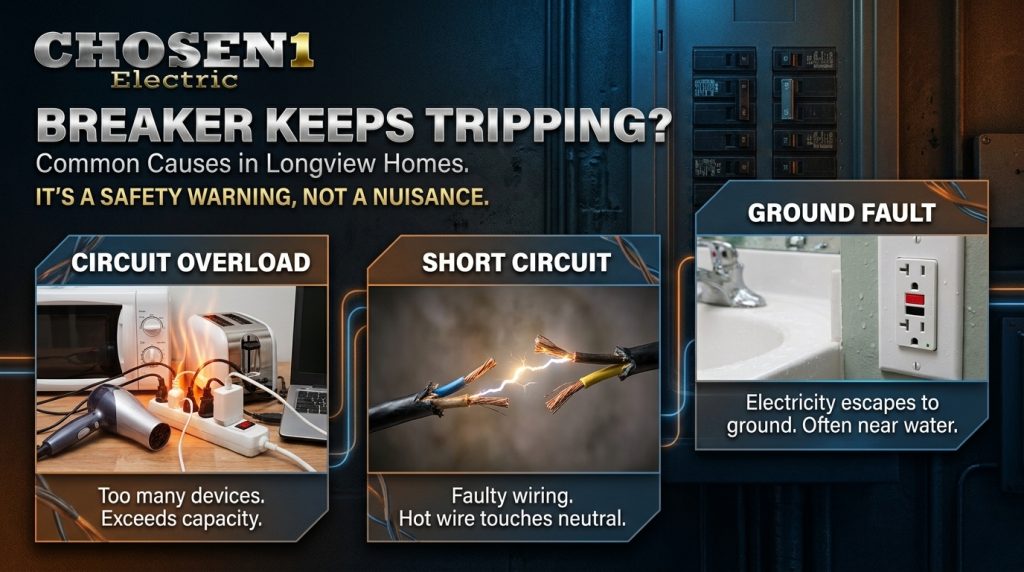
A tripped breaker is annoying. A breaker that trips again — and again — is your electrical system doing its job and telling you something’s wrong. The breaker isn’t the problem; it’s the safety device protecting you from the problem. So before you keep flipping it back on, it’s worth understanding what it’s actually reacting to.
Here’s what’s usually behind a breaker that won’t stay on in a Longview home, what’s safe to check yourself, and when it’s time to stop and call.
What a breaker actually does
Your breaker’s whole job is to cut power when a circuit draws more current than it can safely handle. When it trips, it’s preventing wires from overheating and starting a fire. That’s why repeatedly resetting a breaker without finding the cause is a bad idea — you’re overriding the one device standing between a wiring fault and your drywall.
There are three things a breaker reacts to, and figuring out which one you’ve got is the whole game.
Cause #1: An overloaded circuit (the most common)
This is the everyday culprit. Too many things drawing power on one circuit, and the breaker trips to protect it. You’ll often notice it when you run a space heater, hair dryer, microwave, and toaster on the same part of the house.
What’s safe to try: Unplug everything on that circuit. Reset the breaker once. Plug things back in one at a time, and notice which one pushes it over the edge. If a single high-draw appliance trips it every time, that appliance probably needs its own dedicated circuit — common for window units, space heaters, and shop tools in older Longview homes that were never wired for today’s loads.
If spreading the load across different circuits solves it, great. If the breaker trips with almost nothing plugged in, move on — it’s not a simple overload.
Cause #2: A short circuit
A short happens when a hot wire touches a neutral or ground wire, sending a surge of current through the circuit. The breaker trips instantly and hard. Shorts can come from a damaged appliance cord, a failed device inside an outlet, or rodent-chewed wiring — something East Texas homes with attic or crawlspace runs see more than you’d think.
A short is not a reset-and-hope situation. The Electrical Safety Foundation International points to faulty wiring and damaged cords as leading triggers of home electrical fires, and a short is exactly that kind of fault. If you reset the breaker and it trips immediately every time — especially with a faint burning smell — leave it off and call an electrician.
Cause #3: A ground fault
A ground fault is current escaping where it shouldn’t — often near water. This is what GFCI outlets and breakers are designed to catch, which is why your bathroom, kitchen, garage, and outdoor outlets are on them. If a GFCI keeps tripping, it may be doing its job perfectly (moisture in an outdoor box after a storm) or signaling a real wiring fault.
What’s safe to try: Press the reset button on the GFCI outlet itself. Check outdoor and garage outlets for moisture after rain — a frequent cause in our climate. If it won’t reset or trips right back, there’s a fault to trace.
Cause #4: A failing breaker or panel
Breakers wear out. A breaker that’s been tripped thousands of times, or one that’s old and heat-fatigued, can start tripping at loads it should handle fine — or feel warm to the touch. And if your home still runs an obsolete panel brand (Federal Pacific, Zinsco), the breakers themselves may not trip reliably or may trip constantly. Either way, that’s a panel evaluation, not a breaker you keep resetting.
When to stop and call
Reset a breaker once. If it trips again and you can’t trace it to an obvious overload, stop. Call right away — day or night — if you notice any of these alongside the tripping:
- A burning smell or warmth at the breaker or panel
- Scorch marks or discoloration on the breaker or outlet
- Buzzing, crackling, or sparking from the panel
- The breaker won’t reset at all, or trips the instant you flip it
Those point to a short, arcing, or a failing panel — and they’re why our emergency electrician line has a real person answering around the clock. We’ll help you make it safe over the phone and get a licensed electrician rolling.
How we find the real cause
When the cause isn’t an obvious overload, guessing gets expensive and dangerous. Our diagnostic and troubleshooting calls trace a recurring trip back to its source — we use thermal imaging to find hot connections and circuit tracing to isolate exactly which run and which device is at fault. No tearing open walls hoping to get lucky. We find it, we show you, and we price the fix before we do it.
Why Longview homes see this more
A lot of homes around Longview and Gregg County were wired for a much smaller electrical appetite than a modern household has. Add an extra fridge, a window unit, a shop full of tools, and a couple of space heaters in January, and circuits that were fine for decades start tripping. Storm season doesn’t help — surges and moisture both push GFCIs and breakers to trip. A breaker that suddenly started tripping after a storm is worth having looked at.
The bottom line
A breaker that keeps tripping is a symptom, not the disease. Rule out a simple overload by unplugging and reintroducing loads one at a time. But if it trips with little plugged in, won’t reset, or comes with any smell, heat, or sound — stop resetting and bring in a licensed electrician. You’re not fixing the breaker; you’re finding what the breaker is protecting you from.
We cover Longview and the surrounding East Texas counties with master-licensed electricians and written pricing before any work starts.
Breaker won’t stay on? A real person answers, day or night. Schedule a visit or call (903) 225-8558.
.webp&w=3840&q=75)