Home EV Charger Installation in East Texas: What It Takes
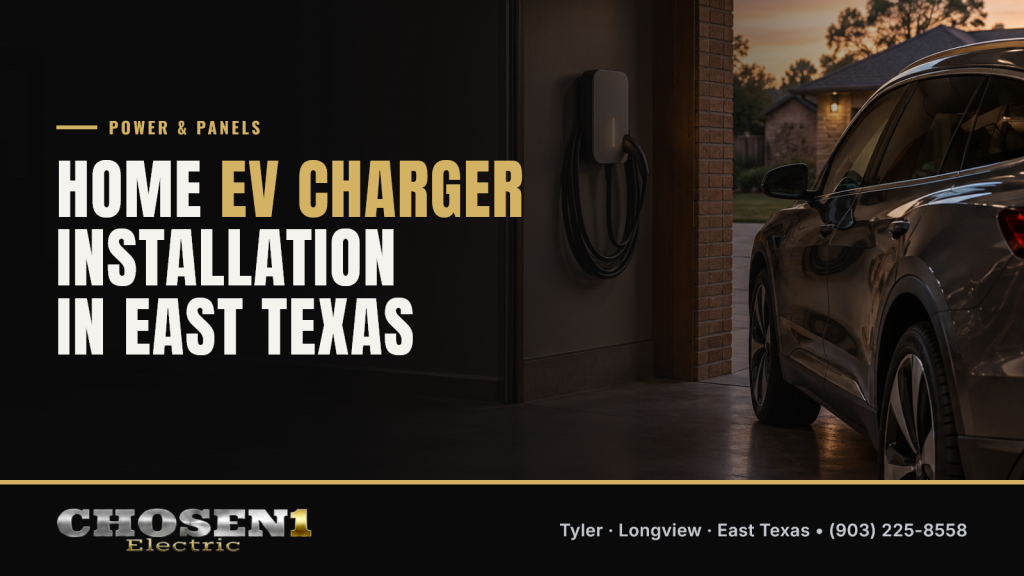
It’s 6 p.m. in Tyler, you’ve just pulled the new EV into the garage, and you plug it into the same outlet you use for the shop vac. The next morning the battery has barely moved. That’s the moment most East Texas drivers start asking about a home charger, and the first question is almost always the same: what does it take to get one installed?
The honest answer is that home EV charger installation depends far more on your electrical panel and your wiring than on the charger itself. Below, we walk through what actually drives the cost, what to check before you buy, and when to bring in a licensed electrician. If you’re ready to get started, our EV charger installation service covers the whole job.
The short answer: what a home charger installation involves
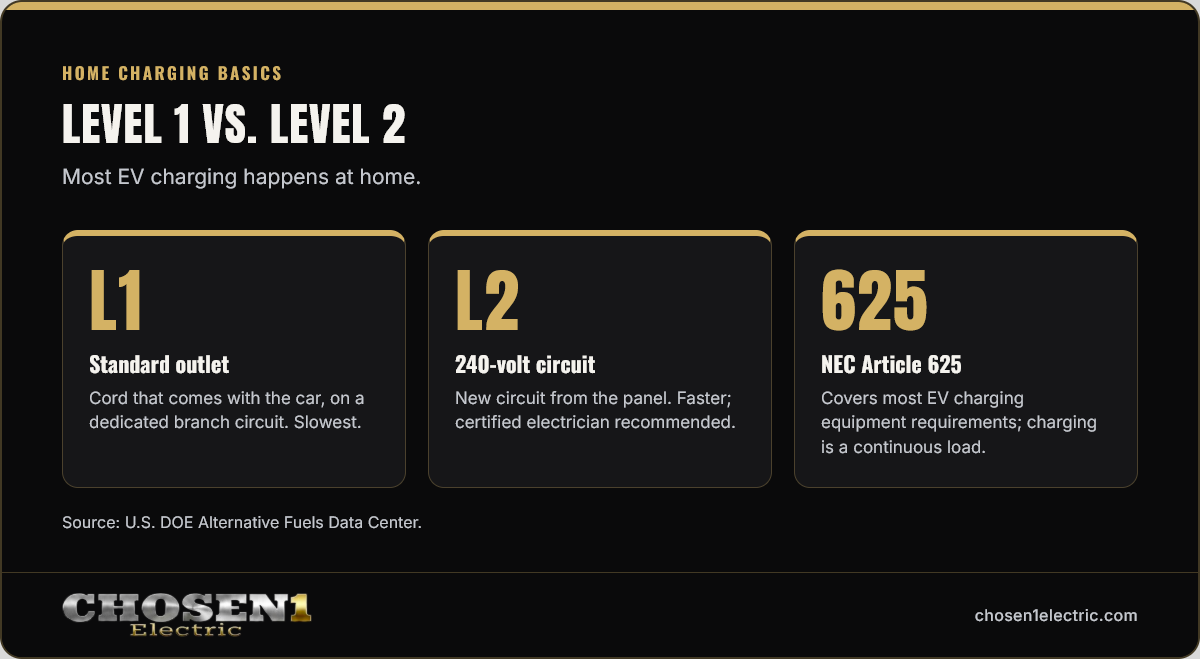
According to the U.S. Department of Energy’s Alternative Fuels Data Center (AFDC), most EV charging happens at home. Every new EV can charge from a standard household outlet using the cord that comes with the vehicle, which is called Level 1 charging. It works, but it’s slow, and the AFDC notes it assumes an outlet on a dedicated branch circuit near where you park.
Level 2 charging runs on 240 volts, the same kind of power your electric dryer or range uses. It’s the setup most owners want because it can refill a battery overnight. For Level 2, the AFDC says an electrician can confirm whether your home has enough electrical capacity and add circuits if it doesn’t, and it recommends hiring a certified electrical contractor.
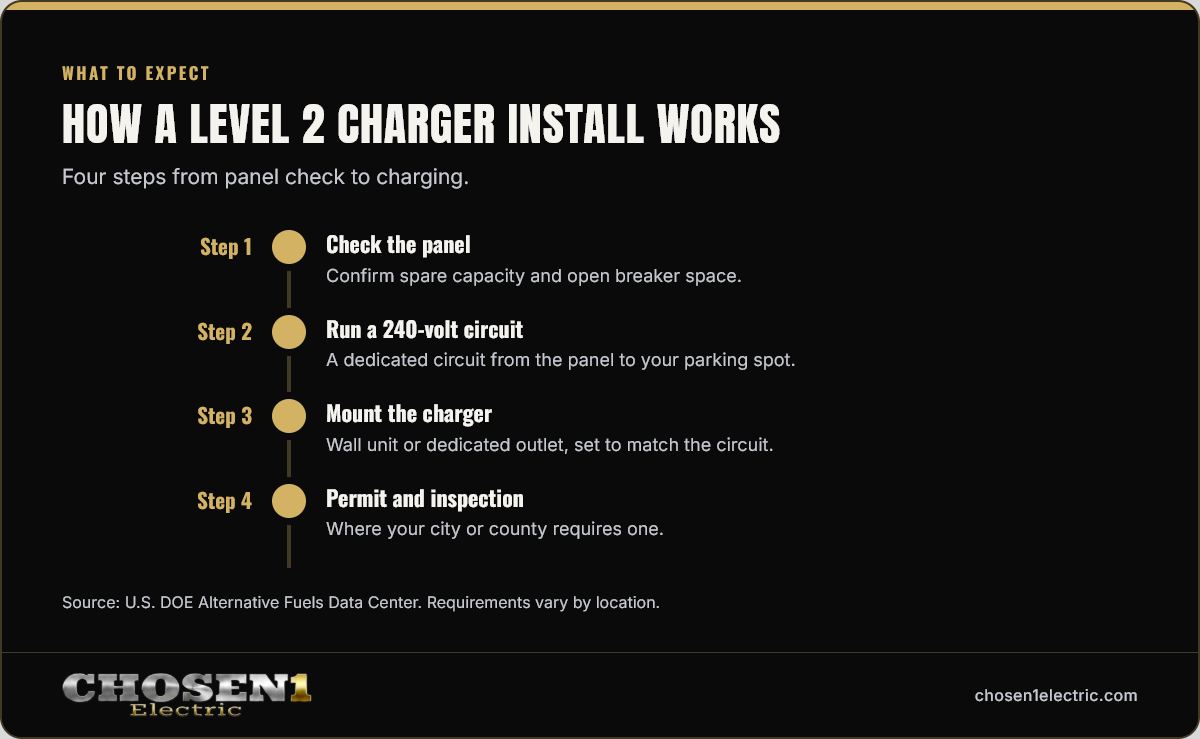
In practical terms, a Level 2 installation usually means four things: a new dedicated 240-volt circuit run from your panel, a breaker sized for the charger, a wall-mounted charging unit or a dedicated outlet, and a permit and inspection where your city or county requires one.
What drives the cost of an EV charger install
We’re not going to quote you a one-size-fits-all number, because there isn’t one. Two homes on the same street can have very different jobs. These are the factors that move the price most.
- Panel capacity. If your panel has open breaker slots and enough spare capacity, the job is simple. If it’s full or already near its limit, you may need a load calculation, a smaller charger, or a panel upgrade. See our guide to 200-amp panel upgrades in East Texas if that sounds familiar.
- Distance from the panel to the charger. The longer the wire run, the more cable and labor. A garage wall that backs up to the panel is the easy case. A detached garage or a panel on the far side of the house is not.
- Wire path. Running cable through an unfinished attic or open garage studs is quicker than fishing it through finished walls, brick, or a slab.
- Charger amperage and type. A higher-amp charger needs a larger breaker and heavier wire. Some chargers hardwire to the circuit and others plug into a 240-volt outlet; an electrician can tell you which suits your setup.
- Permits and inspection. The AFDC says local building and permitting authorities may require permits, and a site installation plan may need approval before work starts. Requirements differ by city and county.
- Outdoor or detached installs. Outdoor mounting, trenching to a detached garage, and weather-rated equipment all add scope.
That’s why a trustworthy electrician looks at your panel and your garage before putting a price on the job. Be wary of any quote given sight unseen.
Level 1 vs. Level 2: which one do you actually need?
Level 1 and Level 2 aren’t competing products so much as two ends of a range. Level 1 is a plug-in-and-go option with no installation, in most cases. Level 2 is faster, but it requires a new circuit.
Charging speed is usually described in miles of range added per hour. The exact figure depends on your vehicle’s onboard charger and the size of the circuit, so it varies. As a rough guide, Level 1 adds a handful of miles per hour, while Level 2 adds several times that. Check your vehicle manual for its maximum charging rate, because a car limited to a lower rate won’t charge faster just because you installed a bigger charger.
Ask yourself a few honest questions:
- How far do you drive each day? A short commute can often be covered by Level 1 overnight. A long daily drive, a work truck with a big battery, or two EVs in the household points to Level 2.
- Do you need to top off quickly? If you come home late and leave early, or want to recover after a long weekend trip to Dallas or Shreveport, Level 2 gives you that margin.
- Is your outlet really on its own circuit? The AFDC’s Level 1 guidance assumes a dedicated branch circuit. A garage outlet shared with lights, a freezer, or a workbench is not a good fit for hours of continuous charging.
Why the circuit sizing matters
Charging a car isn’t like running a toaster. It draws power for hours at a time. The AFDC points out that the National Electrical Code (NEC) treats EV charging as a continuous load, and that Article 625 of the NEC covers most requirements for charging equipment. In plain terms, that’s why the circuit and breaker for a charger are typically sized with some headroom above the charger’s rated draw rather than right at it.
We don’t recommend working out those numbers yourself. The right wire gauge, breaker size, and charger setting depend on your equipment, the code edition your local inspector enforces, and the load already on your panel. Getting that wrong is how circuits run hot, breakers trip repeatedly, and connections degrade over time. If a breaker is already acting up, our guide to why breakers keep tripping in Longview homes explains what to look for.
Choosing safe, certified equipment
The AFDC recommends safety-certified charging equipment, such as units tested by a nationally recognized testing laboratory and ENERGY STAR-labeled products. A certification mark on the label is one of the simplest ways to separate a quality charger from a bargain-bin import.
A few other things to look for when shopping:
- A hardwired or properly rated plug-in design. The cord, plug, and receptacle should be rated for continuous use at the charger’s amperage.
- Adjustable output. Many chargers let an electrician set the amperage to match the circuit, which helps if your panel has limited spare capacity.
- Weather rating. If the charger will be mounted outside or in an open carport, choose one rated for it.
- Cable length. Measure from the mount point to the charge port on your car. A cable that barely reaches tends to get stretched, pinched, or left on the floor.
Is there still a federal tax credit for a home charger?
This is the question we get most, and the answer changed recently. The federal alternative fuel vehicle refueling property credit (Section 30C) used to help offset the cost of home charging equipment. According to the IRS, the credit will not be allowed for any property placed in service after June 30, 2026. Because that date has passed, a charger installed now does not qualify.
Some utilities, cities, and manufacturers run their own rebate or incentive programs, and those change often. Check with your electric provider before you buy. As always, a tax professional is the right person to answer questions about your own return.
East Texas considerations
Our climate and housing stock add a few wrinkles that you won’t see in a generic national guide.
- Heat. A garage in a Texas summer can get very hot, and heat is not kind to electrical connections that carry a continuous load. Solid terminations and correctly sized wire matter.
- Older homes. Many East Texas homes have panels sized for a different era, with little spare capacity for a car-sized load. If your home has older wiring, have it inspected first. Our electrical inspection is a good first step.
- Storms and outages. Thunderstorm season brings surges, and an EV charger is an expensive piece of electronics. A whole-home surge protection setup helps protect it, along with everything else in your house. Read more in our guide on whole-home surge protection for East Texas storm season.
- Detached garages and shops. Many rural properties have a shop or a detached garage that’s a long way from the main panel. Feeding it correctly can involve trenching and a sub-panel, which we handle with our shop and shed wiring work.
Warning signs your setup isn’t ready
If you’ve already started charging at home, watch for these signs that your circuit needs attention.
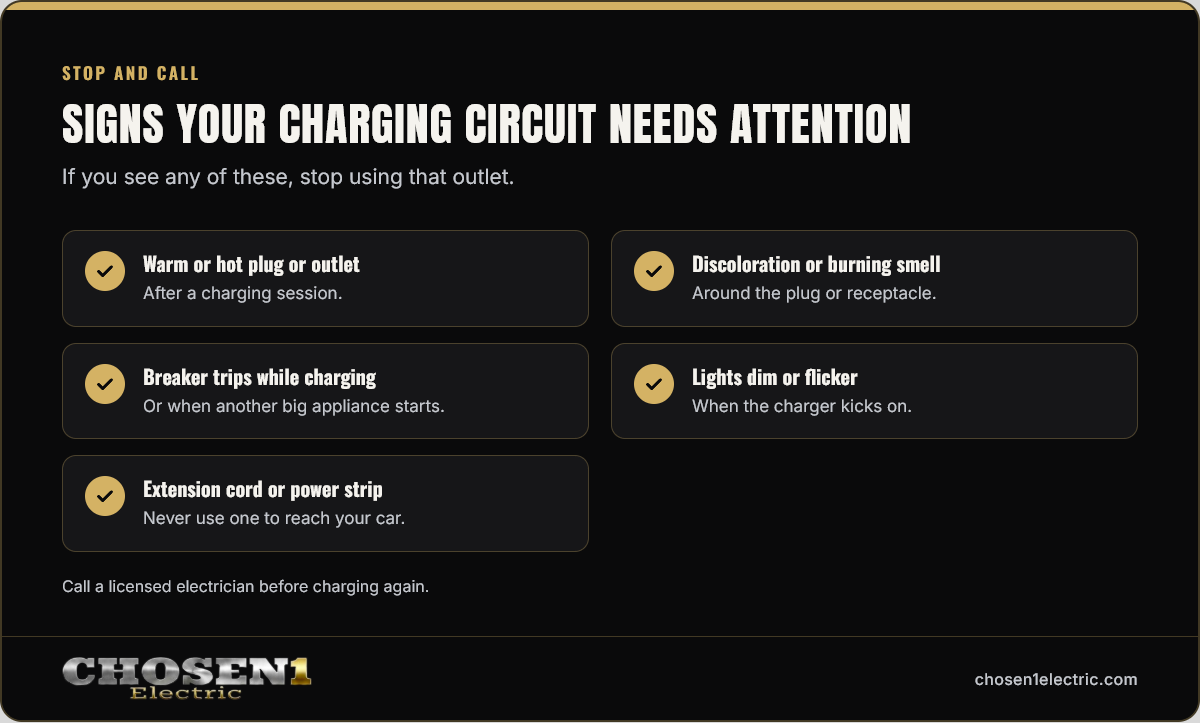
- The plug, cord, or outlet is warm or hot to the touch after charging.
- You see discoloration, melting, or a burning smell around the outlet or plug.
- The breaker trips during charging or when another large appliance starts.
- Lights dim or flicker when the charger kicks on. Our piece on why lights flicker covers the common causes.
- You’re relying on an extension cord or a power strip to reach your car.
If you notice any of these, stop using that outlet and call an electrician. Don’t keep charging on a circuit that’s showing heat damage.
When to call a pro
Level 1 charging from a healthy dedicated outlet is something most people can do on their own. Everything else belongs with a licensed electrician. Call us if:
- You want a Level 2 charger and don’t have a 240-volt circuit near your parking spot.
- Your panel is full, older, or close to capacity, and you’re not sure it can handle the added load.
- Your garage is detached, or the panel is far from where you park.
- You’d like a permit and inspection handled properly, so the work is documented.
- You’re adding a second EV or planning for one down the road.
We start with a look at your panel and the path from it to your parking spot, then recommend the charger, circuit, and permit steps that fit your home. Our team handles electrical panel services and new electrical services in the same visit when the panel needs work. We serve homeowners in Tyler, Longview, and across East Texas.
Frequently asked questions
Do I need an electrician to install an EV charger?
For Level 1, you typically just plug into a suitable outlet. For Level 2, the AFDC recommends a certified electrical contractor, since it involves a new 240-volt circuit and may require a permit.
Can I use a regular outlet to charge my EV?
Yes, that is Level 1 charging, using the cord that came with the car. The AFDC says it should be an outlet on a dedicated branch circuit near where you park. It’s slow, so many owners eventually add a Level 2 charger.
Will my panel handle a Level 2 charger?
It depends on your panel’s capacity and the other loads in your house. An electrician can run a load calculation. Sometimes a lower-amp charger fits, and sometimes a panel upgrade is the better long-term answer.
Is there still a tax credit for home EV chargers?
The federal Section 30C credit does not apply to property placed in service after June 30, 2026, according to the IRS. Check with your utility for any local incentives.

Thinking about a charger for your garage? Call Chosen 1 Electric at (903) 225-8558 and we’ll set up a visit to look at your panel and plan the install.