Can You Plug a Window AC Into an Extension Cord?

It’s mid-July in East Texas, the central air can’t keep up with the back bedroom, and a window unit looks like the quick fix. You carry it home, set it in the window, and then notice the outlet is on the other side of the room. The extension cord from the garage is right there. It reaches. So it should be fine, right?
Not really. Window and portable air conditioners are among the hardest-working plug-in appliances in a house, and the way they get plugged in matters more than most people realize. Below we’ll cover why manufacturers say to avoid extension cords, how to tell whether the circuit behind your outlet can handle an AC, and when it makes sense to have an electrician add a proper outlet or dedicated circuit instead of improvising.
The short answer: plug it straight into the wall
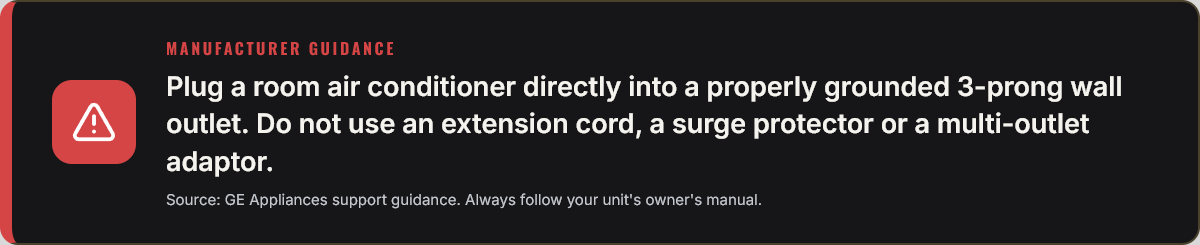
The clearest guidance comes from the people who build these units. GE, for example, says its room air conditioners must be plugged directly into a properly grounded 3-prong wall outlet, and states plainly: “We strongly recommend against the use of an extension cord or surge protector with an air conditioner.” It also says not to plug the appliance into a multi-outlet adaptor. For the specific electrical requirements of your model, GE points owners to the owner’s manual and installation instructions, and that’s where you should look for yours too.
We agree with that approach, and it matches what we see in East Texas homes. If the cord doesn’t reach, the answer isn’t a longer cord. The answer is a better outlet location, a different spot for the unit, or an electrician adding a receptacle where you actually need one.
Why an air conditioner is hard on cords and outlets
Most small appliances draw a trickle of power for a few minutes. An air conditioner is the opposite. The compressor and fan can pull a heavy, steady load for hours at a time, and it can pull harder when it starts than while it’s running. A standard household extension cord is built for lamps, fans, and phone chargers. Run a big appliance through it for an entire afternoon and the cord, the plug, and the connection points can warm up.
Heat is the enemy here. A cord or plug that runs warm for hours is a problem waiting to happen, and it’s often tucked behind furniture or under a rug where nobody notices. A power strip adds another set of contacts for the same current to squeeze through. The Electrical Safety Foundation International (ESFI) makes a related point worth remembering: power strips and surge protectors don’t give you more power at a location, only more access to the same limited capacity of the circuit they’re connected to.
It isn’t just the cord: check the circuit
Even with the AC plugged straight into the wall, the circuit behind that outlet matters. A standard 15-amp household circuit at 120 volts can deliver a maximum of 1,800 watts (15 amps × 120 volts). Electricians generally plan for loads that run for hours to stay at or below 80 percent of a circuit’s rating, which works out to roughly 1,440 watts on a 15-amp circuit.
Here’s the part many homeowners don’t know: several outlets and lights can share one breaker. The outlet for your window unit might also feed the bedroom lamps, a TV, a space fan, and the outlets on the opposite wall. Everything running on that breaker counts toward the same limit, and the air conditioner is usually the biggest part of it.
To get a quick read on your situation:
- Find the AC’s label. The nameplate or manual lists the electrical requirements for that unit. Some larger room units are built for 240 volts and need a different receptacle altogether, so don’t assume any outlet will do.
- Find out what else shares the circuit. Turn off the breaker for that outlet and see what goes dead. Note every light, outlet, and appliance that’s affected.
- Keep other big loads off it. Space heaters, hair dryers, microwaves, and window units in the same room are common circuit-sharing mistakes.
- If the breaker trips, don’t reach for a bigger breaker. That’s a bad fix we’ll cover below. Call a pro.
If your breakers already trip in the summer, our guide to common causes of breakers tripping in Longview homes covers the usual suspects.
Common myths about plugging in an AC
A few ideas float around every summer, and they’re worth correcting before somebody trusts them.
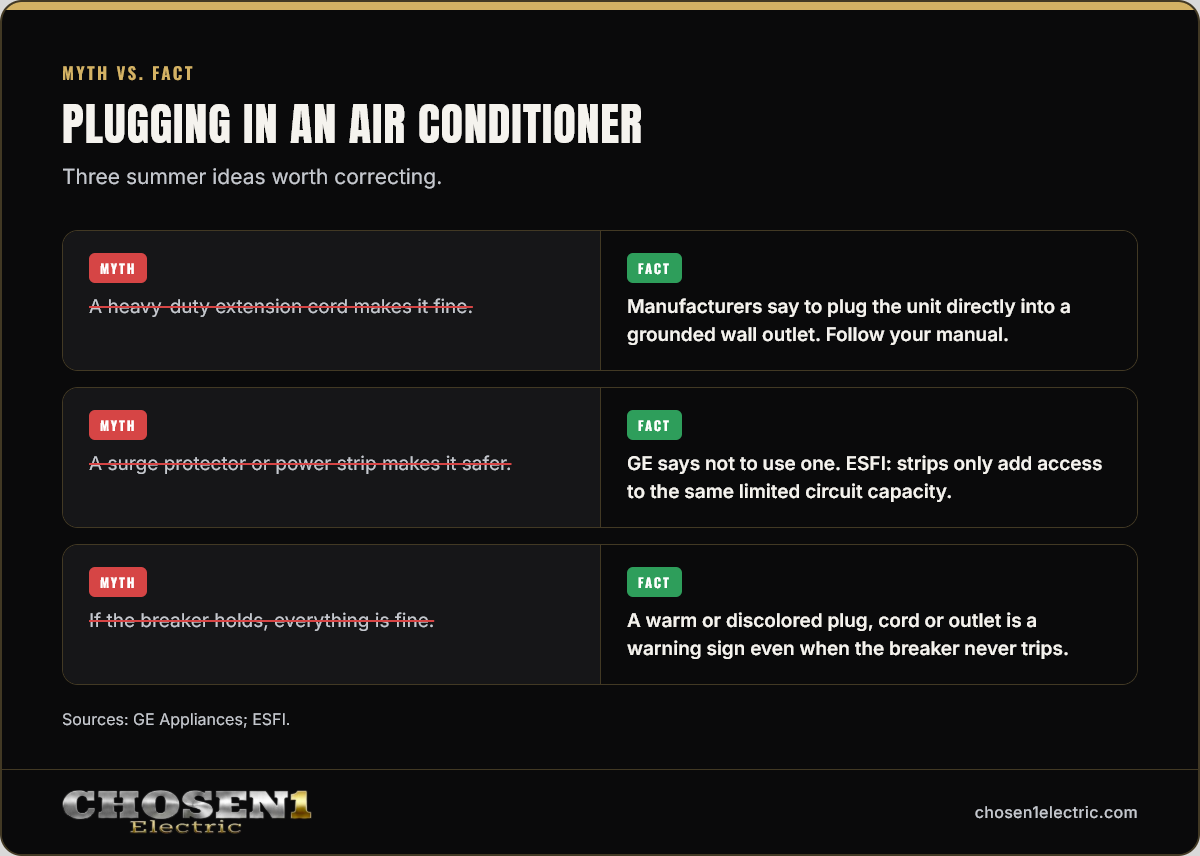
That doesn’t mean every cord is dangerous in every situation. It means the manufacturer’s instruction is the one to follow, and a cord that’s meant to solve a one-week problem has a way of staying in place all season.
East Texas specifics: garages, shops, and additions
The extension-cord problem shows up in places that have grown over the years. A lot of homes around Tyler and Longview have a converted garage, a back bedroom addition, a workshop, or a detached shed where the original wiring was never meant to support a cooling load. Those spaces often have only a couple of outlets, sometimes on a long run from the house, and they’re exactly where people reach for a window unit and a cord.
If you cool a shop or detached building, it’s worth thinking about the wiring from the start. Our shop and shed wiring service covers sub-feeds, dedicated circuits, and outlets sized to the equipment you actually run.
Older homes bring their own wrinkles. A panel that was installed before everyone owned multiple air conditioners, an EV, and a stack of electronics may be close to its limit. If lights dim when the AC starts, that’s worth a look, and we explain the reasons in why lights keep flickering. If you’re stretching a 100-amp service, our guide to 200-amp panel upgrades in East Texas explains when it’s time.
Warning signs to stop and unplug
If you’re running a window or portable AC and notice any of the following, unplug the unit and have the setup checked before you use it again:
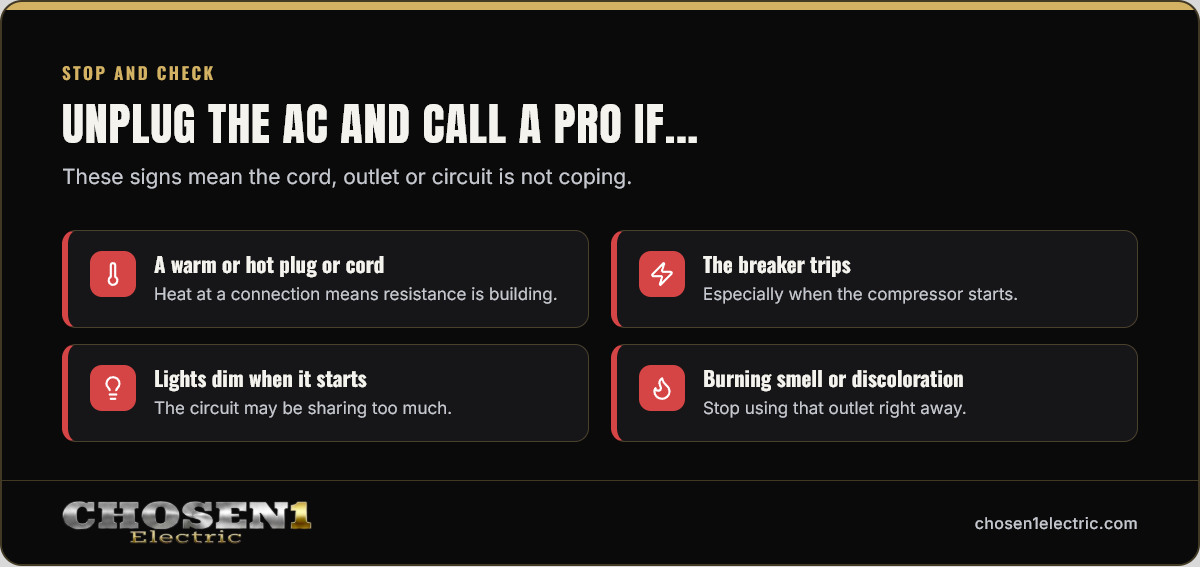
A hot or discolored plug or outlet is an especially important one. It means resistance is building up at a connection, and that heat has nowhere to go but into the plastic around it.
Never solve a tripping breaker with a bigger breaker
When the breaker trips every time the AC starts, the instinct is to swap in a higher-rated breaker. Don’t. The breaker is sized to protect the wire inside the wall. A larger one can let that wire overheat before anything trips. If a circuit can’t carry what you need, the fix is a different or additional circuit, not a bigger breaker. This is also where our diagnostic and troubleshooting work comes in: finding out whether the problem is an overloaded circuit, a loose connection, or a failing outlet.
What an electrician can do instead
Rather than running a cord across the room, a licensed electrician can usually give you a permanent solution:
- Add an outlet where the unit actually sits. No cord, no adapters, and no tripping hazard.
- Install a dedicated circuit. The AC gets its own breaker, so it’s not competing with lamps and TVs.
- Replace a worn outlet. A loose or heat-damaged receptacle is a common cause of trouble under a heavy load.
- Check the panel. If there are no open spaces or the panel is aging, we’ll tell you whether it needs attention.
For storm-season protection of the electronics you’re cooling, you may also want to read our post on whole-home surge protection for East Texas. We serve homes in Tyler, Longview, and across East Texas.
Frequently asked questions
Can I use an extension cord with a window air conditioner?
Manufacturers say no. GE, for example, strongly recommends against using an extension cord or surge protector with an air conditioner and says the unit must be plugged directly into a properly grounded 3-prong wall outlet. Check your owner’s manual for your model.
Can I plug my air conditioner into a power strip?
No. A power strip or multi-outlet adaptor just routes the same current through more connections. ESFI notes that power strips and surge protectors only give more access to the same limited circuit capacity.
How do I know if my outlet can handle an air conditioner?
Read the electrical requirements on the unit’s label and in its manual, find out what else shares the circuit, and watch for warm plugs or tripping. If you can’t tell, have an electrician look at it.
Does a window AC need its own circuit?
Many people run one on a shared circuit, but a dedicated circuit is the cleanest setup, especially for larger units or any circuit that already feeds other heavy loads. Your unit’s manual lists its requirements.

If your window unit keeps tripping a breaker or you’d rather not run a cord across the room, call Chosen 1 Electric at (903) 225-8558 or schedule a visit and we’ll set you up with a proper outlet.