How Often Should You Replace Smoke and CO Alarms?
When was the last time you checked how old your smoke alarms are? If you can’t answer that off the top of your head, you’re not alone, and that’s the problem. A smoke or carbon monoxide (CO) alarm that looks fine on the ceiling can be well past the point of working. Every fall, when the clocks change and the weather turns, is the right moment to find out.
Here’s the short version of how often to replace smoke and CO alarms, how to check the age of yours, where they belong in your home, and why East Texas storm and heating season makes CO alarms matter even more. If you’d rather have a pro handle it, our smoke detector installation service covers everything below.
The quick answer: replacement and testing schedule
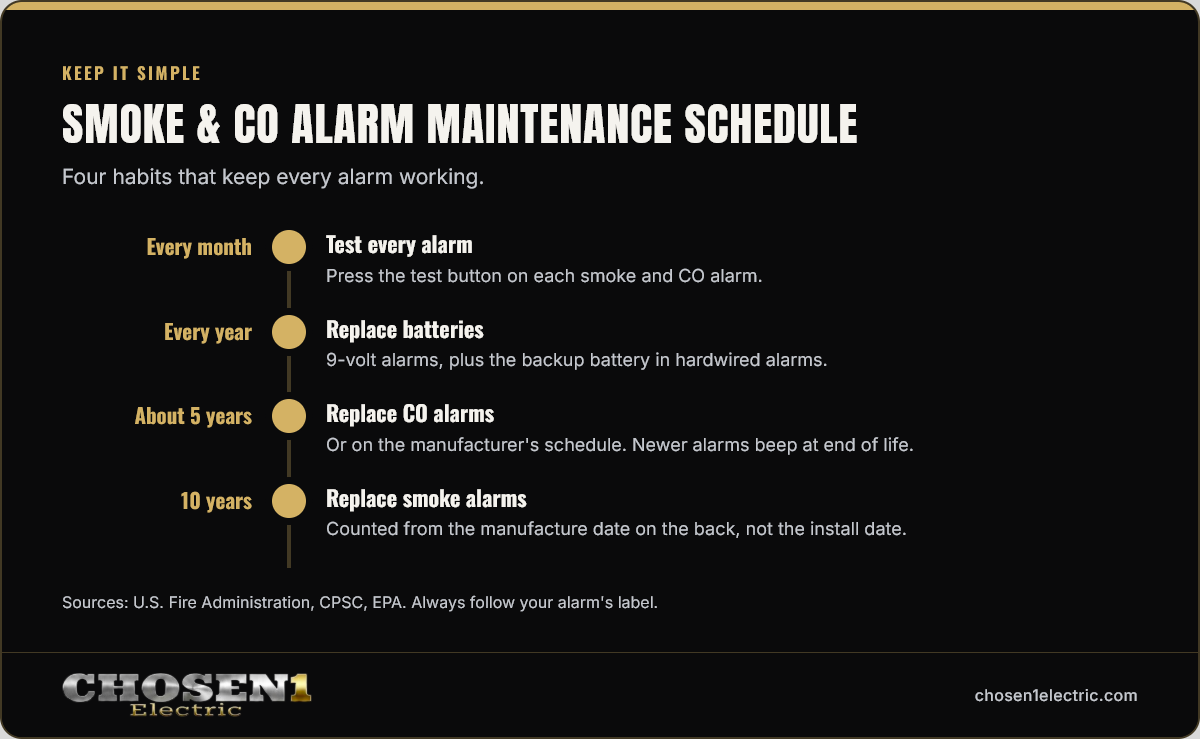
Smoke alarms wear out. According to the U.S. Fire Administration (USFA), a smoke alarm needs to be replaced 10 years from its manufacture date, not its install date. CO alarms have a shorter life: the Consumer Product Safety Commission (CPSC) has advised replacing CO alarms every five years or as the manufacturer recommends, and the EPA’s current guidance is to follow your manufacturer’s instructions on replacement. Newer models beep with an end-of-life signal when they’re finished.
Testing is more frequent than replacement. The USFA and CPSC both say to test your alarms monthly. Batteries need attention too. For alarms with a replaceable 9-volt battery, the USFA says to replace the battery at least once a year. Alarms with sealed 10-year lithium batteries are replaced as a whole unit, on the manufacturer’s schedule.
How to find out how old your alarm is
This takes about a minute per alarm. Twist or pull the alarm off its mounting base and look at the back. Manufacturers stamp the manufacture date there. If the date is more than 10 years ago, or you can’t find a date at all, replace it. The label may also tell you the manufacturer’s exact replacement interval, and that one wins over any general rule of thumb.
Hardwired alarms follow the same rules. Even though they run on your home’s power, they often have a backup battery, and the USFA says to replace that backup battery at least once a year and the entire alarm every 10 years. The USFA also notes that only qualified electricians should install hardwired smoke alarms, so this is one job that’s worth handing off.
Replace an alarm right away if any of these are true:
- It’s more than 10 years past its manufacture date, or it has no date on the back at all.
- It keeps chirping after you’ve installed a fresh battery. NFPA says that means the alarm has reached the end of its life.
- It’s a sealed 10-year-battery model and it’s chirping for a low battery. NFPA says to replace the entire alarm in that case.
- It doesn’t respond when you press the test button, even with a new battery.
That list is the reason a quick walk through the house each fall is worth the time. It takes a few minutes, and it turns up the alarms that have quietly stopped protecting you.
Why an old alarm is a real risk
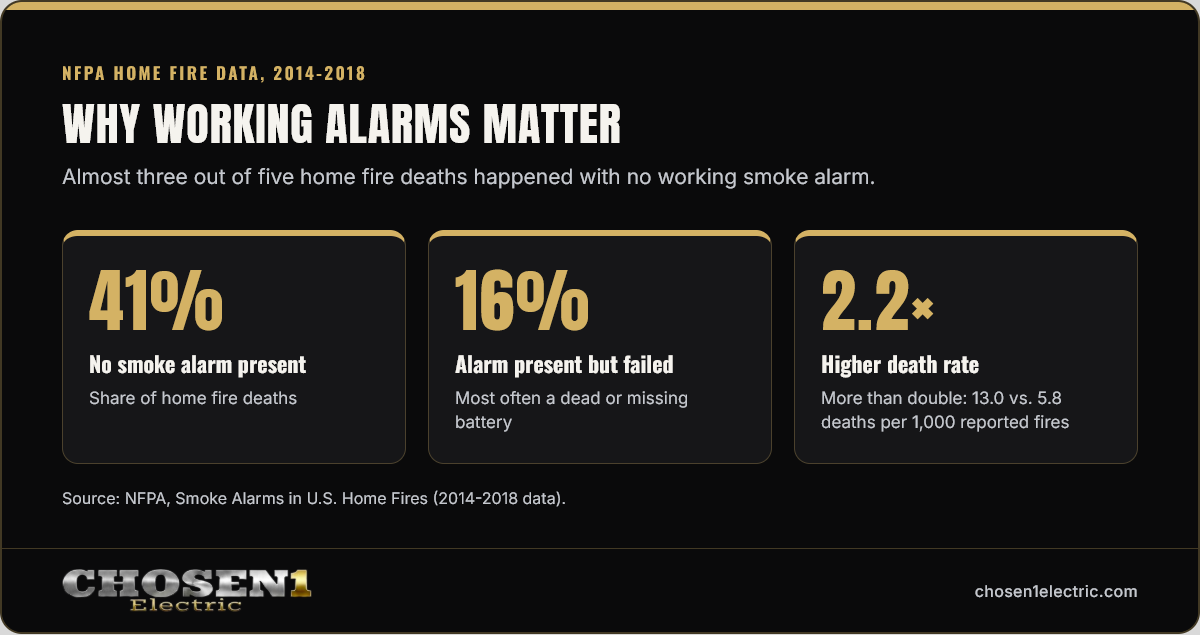
The National Fire Protection Association (NFPA) looked at U.S. home fire deaths from 2014 to 2018. About two in five of those deaths happened in homes with no smoke alarms at all (41 percent), and another 16 percent happened in homes where the alarm failed to operate. Put together, almost three out of five home fire deaths happened in fires with no working smoke alarm.
The most common reasons alarms failed were power problems: missing, disconnected, or dead batteries, and hardwired alarms that had been disconnected. The death rate in homes without a working alarm was more than double the rate in homes with one. That’s why the simple monthly test matters.
Where smoke and CO alarms belong
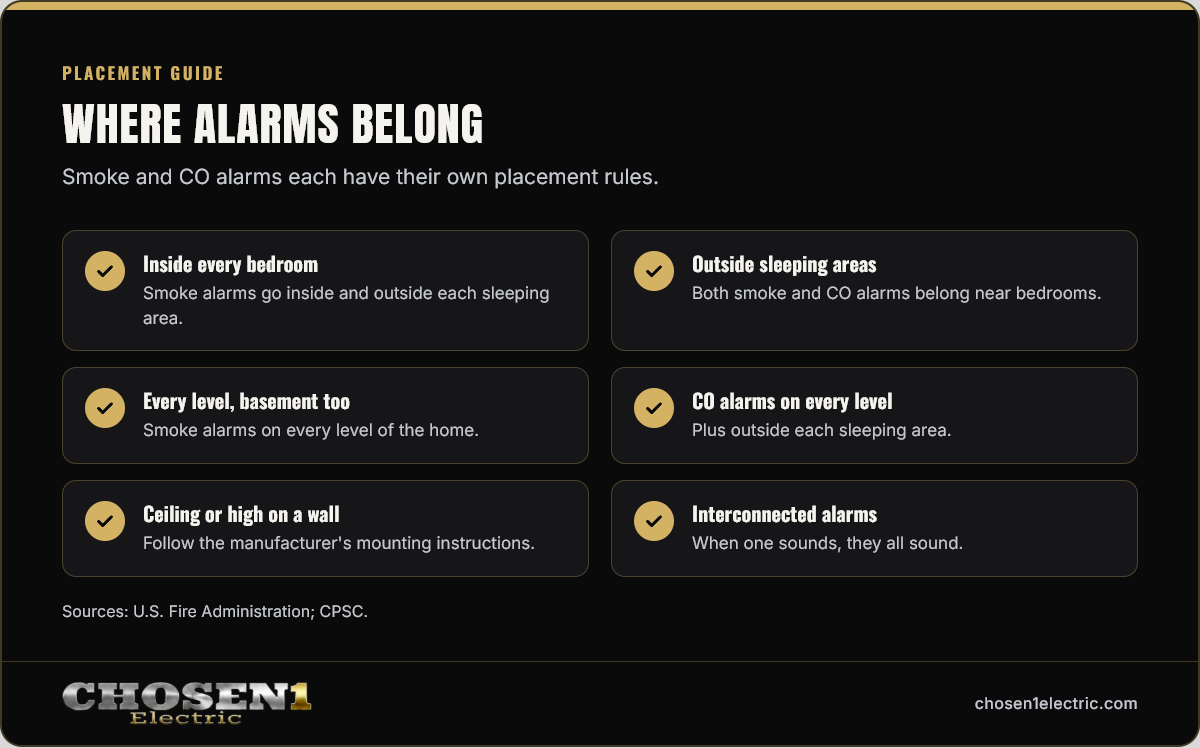
Placement matters as much as age. The USFA recommends installing smoke alarms inside and outside each bedroom and sleeping area, and on every level of the home, including the basement. Mount them on the ceiling or high on a wall, and check the manufacturer’s instructions for the best spot.
For CO, the CPSC says alarms belong on every level of the home and outside sleeping areas. Both agencies recommend interconnected alarms: when one sounds, they all sound, which matters in a larger home where you might not hear an alarm on another floor.
Carbon monoxide in East Texas: storms, generators, and winter heating
East Texas storms mean power outages, and outages mean generators and alternative heat. That’s when CO becomes dangerous. The CPSC reports that more than 200 people in the U.S. die each year from accidental non-fire CO poisoning linked to consumer products, and more than 100 of those deaths are linked to portable generators.
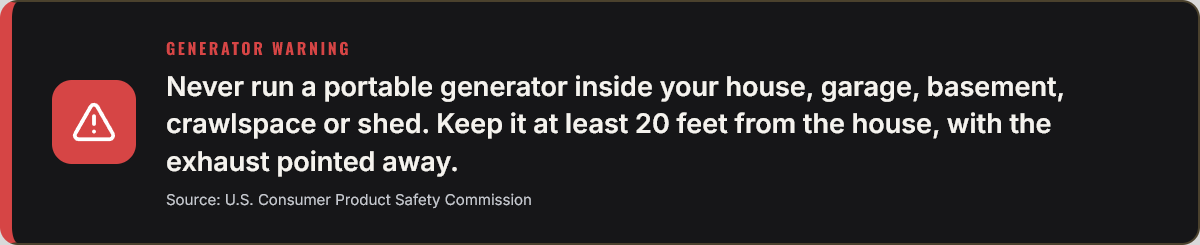
If you run a portable generator, the rule is simple: never run it inside your house, garage, basement, crawlspace, or shed, even with the doors open, and keep it at least 20 feet from the house with the exhaust pointed away. A permanently installed unit changes the picture; see our standby generator installation and generator maintenance services. If you’re also planning for storm season, our guide to whole-home surge protection for East Texas storms is worth a read.
Have fuel-burning appliances, such as a furnace, water heater, or wood or gas heat? The CPSC has recommended having chimneys and fuel-burning appliances checked by a professional so they vent properly.
Interconnected, hardwired, and combination alarms
If your home has just a couple of battery alarms, it may be time for an upgrade. Interconnected alarms, where one sounds and they all sound, are the standard to aim for, and combination smoke and CO alarms are available if you want to cut down on wall clutter. Whether your home’s wiring can support a hardwired, interconnected system is a question for an electrician. That’s where an electrical inspection or a visit from our team comes in.
Nuisance alarms and chirps
A single chirp every 30 to 60 seconds usually means a low battery, according to NFPA. If it keeps chirping after you’ve put in a fresh battery, the alarm has reached the end of its life and needs to be replaced. Your manual will confirm the exact pattern for your model.
If an alarm goes off while you’re cooking, the USFA’s advice is to open a window or door, press the hush button, or wave a towel at the alarm, and never take the battery out while you cook. If an alarm keeps sounding with no smoke, call a professional rather than disabling it.
When to call an electrician
- You want hardwired or interconnected alarms installed or replaced.
- Your home is older and has few alarms or no way to interconnect them.
- An alarm sounds repeatedly with no clear cause.
- You’re not sure your home’s wiring can support what you want.
We serve homeowners in Tyler, Longview, and across East Texas. If something seems wrong tonight, our emergency electrician service is available.
Frequently asked questions
How often should I replace smoke detectors?
Every 10 years from the manufacture date printed on the back, or sooner if the manufacturer says so or the alarm is malfunctioning.
How long do carbon monoxide detectors last?
The CPSC has advised replacing CO alarms every five years or as the manufacturer recommends, and the EPA says to follow your manufacturer’s instructions. Many newer alarms will beep at the end of their life.
Do hardwired smoke alarms still need batteries?
Yes. They usually have a backup battery that should be replaced at least once a year, and the whole alarm should be replaced every 10 years.
Can I replace a hardwired smoke alarm myself?
The USFA says only qualified electricians should install hardwired smoke alarms. A licensed electrician can also make sure the new alarms are compatible and interconnected, which a simple swap can miss.
Should I change alarm batteries when the clocks change?
It’s a good habit. Federal safety agencies have long encouraged people to change batteries and test alarms when clocks change, as long as the battery is replaceable.

Not sure how old your alarms are, or whether your home has enough of them? Call Chosen 1 Electric at (903) 225-8558 and we’ll take care of it.